


What Is Electric Sweepers?The Ultimate Guide to Electric Sweepers 2026
Release time: 2026-04-16
Background
Driven by rising environmental awareness, labor costs and cleaning demands, all-electric sweepers have gradually replaced traditional equipment and become the mainstream choice for industrial, commercial and municipal cleaning. Electric-powered, eco-friendly and highly efficient, they have revolutionized large-area cleaning. This article analyzes all-electric sweepers in five aspects: definition, differences from fuel models, application scenarios, product types and working principles, to help you understand their core value quickly.
I. What Is an Electric Sweeper?
An electric sweeper is an automated cleaning device powered by rechargeable lithium-ion or lead-acid batteries. It combines sweeping, vacuuming and dust suppression in one, running on electricity without fuel to clear ground debris efficiently. Ideal for large indoor and outdoor areas, it is a key alternative to manual cleaning for higher efficiency. Featuring automation, flexible application and low operating costs, it handles dust, gravel, leaves and other waste well. The built-in dust suppression system prevents secondary dust, ensuring eco-friendly cleaning. Easy to operate with no professional skills required, the all-electric sweeper delivers electric-driven, intelligent integrated cleaning, and supports the low-carbon transformation of the cleaning industry.
Electric Sweepers vs. Traditional Fuel-Powered Sweepers
Key Differences and Advantages
Currently, sweepers on the market are primarily divided into all-electric models and traditional fuel-powered models (diesel or gasoline-driven). The two differ significantly in terms of power source, operating costs, environmental friendliness, and user experience. Against the backdrop of tightening environmental policies and rising labor costs, the advantages of all-electric sweepers are particularly prominent. The specific differences and advantages are as follows:
Core Differences
Different Power Sources: All-electric sweepers rely on lithium-ion or lead-acid batteries for power, with electric motors providing propulsion, eliminating the need for fuel; traditional fuel-powered sweepers rely on diesel or gasoline combustion to drive the engine, requiring continuous refueling.
Environmental Performance:
All-electric sweepers produce zero exhaust emissions and operate quietly, causing no air pollution during use and meeting global environmental standards; fuel-powered sweepers emit harmful gases such as carbon monoxide and particulate matter during combustion, generate significant noise, and cause some environmental pollution.
Maintenance Difficulty:
All-electric sweepers have a relatively simple structure, with batteries and motors as their core components. Routine maintenance involves only regular charging, checking battery status, and cleaning the sweeping components, eliminating the need for complex operations such as oil changes or engine maintenance. Fuel-powered sweepers have a complex structure and require regular replacement of parts like engine oil, filters, and spark plugs, making the maintenance process
Different operating costs:
The daily operation of an all-electric sweeper incurs only electricity costs. With low hourly power consumption, the cost of electricity is just one-tenth that of fuel, and maintenance costs are minimal. In contrast, fuel-powered sweepers require ongoing fuel expenses, and fuel prices are highly susceptible to market fluctuations. Combined with high maintenance costs, the long-term operating costs are significantly higher than those of all-electric sweepers.
Advantages of All Electric Sweepers
- Environmentally friendly with zero emissions, suitable for multiple scenarios: With no exhaust fumes or odors, they can be used directly in environmentally sensitive areas such as indoor workshops, food processing plants, and pharmaceutical facilities, as well as in outdoor locations like municipal streets and residential communities. They are not subject to environmental policy restrictions and are particularly suitable for scenarios with high environmental standards.
- Low operating costs, more cost-effective in the long run: Electricity costs are significantly lower than fuel costs. Maintenance is simple with few wear-and-tear parts, and there is no need for complex engine maintenance. This results in substantial annual savings on fuel and maintenance expenses, making them far more cost-effective than fuel-powered sweepers over the long term. According to statistics, the annual operating cost of an all-electric sweeper is only about 30% of that of a fuel-powered sweeper.
- Easy to operate with a low learning curve: Featuring a one-button smart control panel and ergonomic design, the operation process is straightforward. No professional driver’s license or complex training is required; even beginners can operate it proficiently within 15 minutes. It is suitable for a wide range of operators, effectively reducing training costs.
- Easy to operate with a low learning curve: Featuring a one-button smart control panel and ergonomic design, the operation process is straightforward. No professional driver’s license or complex training is required; even beginners can operate it proficiently within 15 minutes. It is suitable for a wide range of operators, effectively reducing training costs.
- Durable construction, suitable for demanding conditions: All-electric sweepers lack complex components such as engines, resulting in a low failure rate. The motors feature an IP54 waterproof and dustproof design, enabling them to withstand harsh industrial environments such as damp and dusty conditions, thereby extending their service life. Additionally, some models are equipped with energy recovery technology, which converts kinetic energy into electrical energy during braking to recharge the battery, effectively extending the operating range by 10–15%.
2.Main Types of Electric Sweepers
Electric sweepers are broadly categorized into walk-behind, ride-on, and robotic models, each tailored to distinct space sizes and cleaning demands. Walk-behind electric sweepers feature a compact, lightweight design with flexible operation, perfect for small and medium areas like office corridors, retail stores, and narrow factory aisles. They are easy to maneuver, cost-effective, and require minimal training for daily operation.
Ride-on electric sweepers deliver higher cleaning efficiency with larger dust bins and stronger power performance. Designed for large-scale scenarios such as industrial workshops, logistics warehouses, parking lots and municipal squares, they reduce labor intensity and cover extensive ground quickly. Many advanced models integrate dust suppression, water spraying and noise reduction functions to meet outdoor and heavy-duty cleaning needs.
In addition, intelligent robotic electric sweepers have gained growing popularity for smart cleaning solutions. Equipped with automatic navigation and sensor technology, they enable unmanned operation, ideal for modern commercial buildings and residential communities. Cordless battery designs are widely adopted across all types, ensuring zero emissions, low noise and eco-friendly operation, making electric sweepers a mainstream choice for modern commercial and industrial cleaning.
- Walk-behind Electric Sweepers
- Ride On Electric Sweepers
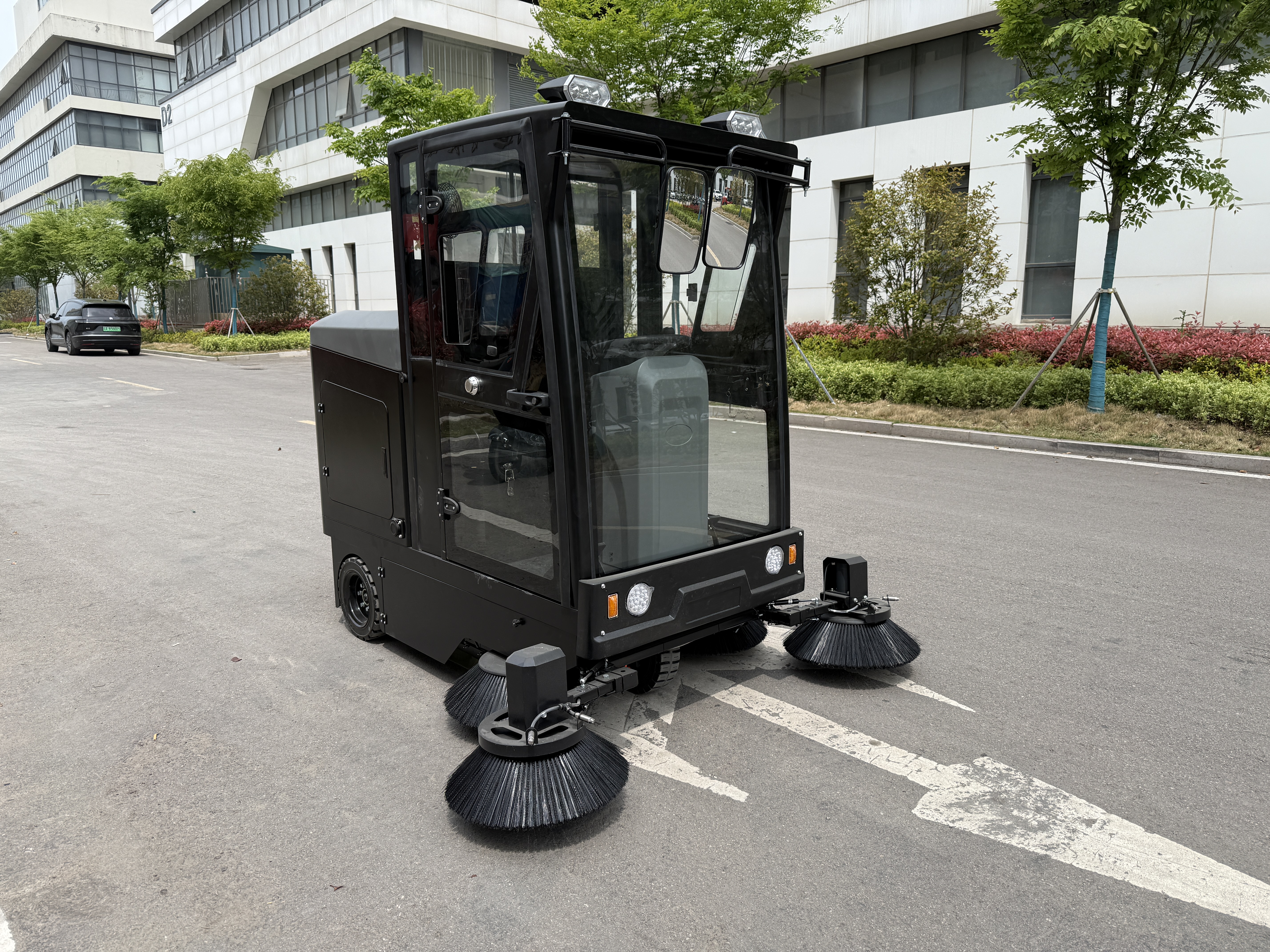
- Fully enclosed cab Electric sweepers
- Self-dumping electric sweeper
3.Core Application Scenarios
The core advantage of all-electric sweepers is “high-efficiency cleaning of large areas.” They are primarily suited for the following four major categories of scenarios, covering a wide range of indoor and outdoor needs:
1. Industrial Settings: Factory workshops, logistics warehouses, industrial parks, and production facilities. These machines are primarily used to sweep up dust, metal shavings, packaging waste, and other debris from the ground. They are particularly suitable for electronics factories, food processing plants, and chemical workshops—where strict environmental and noise regulations apply. Certain explosion-proof models can meet safety requirements in flammable and explosive environments.
2.Commercial Settings: Large shopping malls, supermarkets, office buildings, parking lots, logistics parks, airports, train stations, and similar locations. These vehicles are used to clean paper scraps, fruit peels, dust, and other debris in high-traffic areas, enhancing the cleanliness of the premises. Their low-noise and zero-emission features ensure they do not disrupt the customer experience.
3.Municipal and Public Settings: City streets, parks, plazas, campuses, residential communities, and municipal green belts. These vehicles are used to clear fallen leaves, dust, cigarette butts, and debris, replacing manual cleaning to improve municipal cleaning efficiency and support low-carbon urban development. They are also suitable for cleaning narrow areas such as platforms and waiting halls at transportation hubs.
4.Other Special Scenarios: Locations with extremely high requirements for environmental cleanliness and low noise levels, such as hospitals, nursing homes, and scenic areas, as well as areas with poor ventilation like underground parking garages and enclosed workshops. The zero-emission and low-noise advantages of all-electric sweepers make them a perfect fit for these environments.
4.Working Principle of Electric Sweepers
The core working principle of all-electric sweepers is “converting electrical energy into mechanical energy, and through the coordinated operation of multiple components, achieving waste sweeping, collection, and storage.” The overall structure is simple, primarily consisting of four core components: the power system, sweeping system, vacuum system, and control system. These components work together to complete the cleaning process. The specific principles are as follows:
(1) Core Power Source: Electric Drive
The core power source of a pure electric sweeper is a rechargeable battery (primarily lithium-ion, with some models using lead-acid batteries). The battery supplies electrical energy to various motors, providing power for the sweeper’s movement, sweeping, and vacuuming functions. The motors typically use DC brushed or brushless motors. Brushless motors offer higher efficiency and longer service life. After speed reduction via a gearbox, they drive the sweeping brush deck or the drive wheel system. Their torque output characteristics are particularly well-suited for sweeping operations that require frequent starts and stops. The control system integrates an MCU intelligent management module that monitors motor load in real time, enabling precise speed control and overload protection.
(2) Sweeping Process: Four Major Components Working in Concert
- Drive System: The battery powers the drive motors, which rotate the wheels to enable the sweeper to move forward, backward, and turn. The operator controls the direction and speed via a steering wheel or handle. Some smart models support automatic navigation and obstacle avoidance, eliminating the need for manual control.
- Debris Sweeping: The underside of the sweeper is equipped with a main brush (roller brush) and side brushes. The side brushes are symmetrically mounted on both sides of the chassis and are driven by a sweeping motor to rotate at high speed, gathering debris (dust, paper scraps, gravel, etc.) from both sides of the ground toward the center of the vehicle; The main brush (roller brush) is located at the center of the vehicle’s underside. It rotates at high speed to sweep the gathered debris into the waste collection bin. It can also automatically adjust its height based on the ground’s levelness to ensure thorough cleaning and adapt to various surfaces such as concrete, asphalt, and paving stones.
- Dust Suction and Suppression: During the sweeping process, the vacuum motor activates to generate negative pressure, drawing dust generated during sweeping into the suction duct. After passing through a filter, the dust is collected in the dust bin, while clean air is expelled, preventing secondary dust dispersion. Some models are equipped with a misting system that sprays water mist during operation to further suppress dust, maintaining clean air in the work environment—particularly suitable for dry, dusty industrial settings.
- Waste Storage and Disposal: Swept debris is directed by the main brush into the waste collection bin (or dust bin). Once the bin reaches a certain capacity, the operator can manually empty it (push-type models) or use a one-button control for automatic dumping (self-dumping models) to complete waste disposal. Some models feature removable and washable waste collection bins for easy cleaning, along with a filter cleaning function to reduce maintenance workload
Summary
As low-carbon, efficient, and convenient cleaning equipment, all-electric sweepers not only address the pain points of traditional fuel-powered sweepers—such as high pollution, high costs, and difficult maintenance—but also adapt to diverse cleaning scenarios, making them the core choice for upgrading the cleaning industry today. Whether in industrial production, commercial operations, or municipal cleaning, selecting the appropriate type of all-electric sweeper can not only improve cleaning efficiency and reduce labor costs but also put environmental protection principles into practice, achieving the multiple benefits of “cleanliness + energy savings + environmental protection.” With the continuous advancement of battery and smart technologies, the range, efficiency, and functionality of all-electric sweepers will continue to improve, making them the mainstream trend in the future cleaning industry.